Download Water test Regulations in Adobe pdf format here
Download Section C excercises in Adobe pdf format here
Relaxing - Watermead Tests 2007
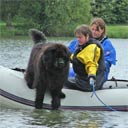
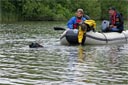
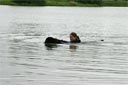
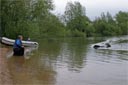
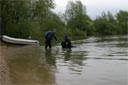
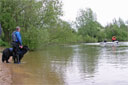
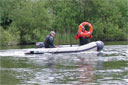
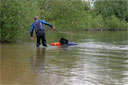
EXERCISE 1 - Jump from boat and tow 25 to 30 metres to shore
Purpose - To demonstrate a dog's ability to respond to the owner's commands and jump from a boat then tow it 25 to 30 metres to shore. Without
endangering itself or any person.
Desired performance - The dog and owner, in a controlled manner, will enter the boat containing a steward, the boat steward and a Judge. The boat
will then be taken 25 to 30 metres from the shore. When given the signal to begin, the dog shall enter the water; take the boat's tow rope in its mouth
and tow the boat directly back to the shore. The instruction to the dog can be supplemented by splashing or tossing the tow rope into the water. The owner
must remain in the boat until the test is completed. The Judge shall indicate that the exercise is complete when the boat is within reach of the handler
and the boat occupants could step ashore safely in less than knee depth water.
Scoring - Points will be lost for:
not entering the boat safely at the shore;
excessive anticipation or lack of control;
hesitation in entering the water when commanded by the owner;
hesitation in taking the rope when commanded;
attempting to re-enter the boat;
dropping the rope;
not swimming directly back to the shore;
not bringing the boat within reach of the handler;
the dog being physically redirected;
not leaving the water when instructed.
The pass mark is 18 out of 25.
Failure -
Exceeding the 4 minute limit for completing the exercise.
Not exiting the boat in the first 60 seconds of the exercise.
Owner physically assisting in the exit from the boat.
Not towing the boat by holding the rope voluntarily in its mouth.
Owner holding both ends of the rope.
Owner holding the rope in a loop, however loosely.
Owner holding rope either side of the dogs mouth.
Permitted actions -
The tow rope must float and must not have anything at the towing end, other than a plain back-splice or whipping. The rope shall be between 35 and 65
mm in circumference and heat sealed where necessary.
The tow rope will not be attached to the boat but will be held (firmly) by the owner, one end of the rope must remain free. The end of the rope can be
given directly to the dog or it can pick it up from the water.
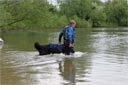
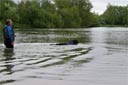
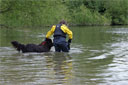
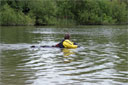
Purpose - To demonstrate a dog's ability to respond to the owner's commands and swim 25 metres out to a stranger and then return with him to the
shore without endangering itself or any person.
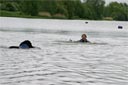
Desired performance - The dog will remain on shore, under control, at the side of the owner, until instructed to begin. The water steward (who
is a stranger to the dog, i.e. not from its normal training group) will swim out at least 25 metres from the shore, turn, face the shore and wait. On
being given the indication from the Judge, they will attract the dog's attention by calling AND splashing in the water. They will continue to attract
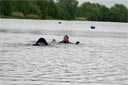
the dog's attention until the dog is within touching distance. Upon command from the owner, the dog will swim directly to the steward, effect a safe pick-up
and tow him back to the shore. The Judge shall indicate that the exercise is complete when the steward is in shallow water near the shore.
Scoring - Points will be lost for:
excessive anticipation or lack of control;
hesitation in entering the water;
the dog being physically redirected;
not swimming directly to the person;
not turning when instructed;
not effecting a safe tow;
not swimming directly back to the shore;
not bringing the steward to shallow water;
not leaving the water when instructed.
The pass mark is 18 out of 25.
Failure -
exceeding the 4 minute limit for completing the exercise.
attempting to climb on the water steward.
Permitted actions -
The dog is encouraged to wear a harness to provide a safe handhold when towing.
When attracting the dog's attention the steward is NOT permitted to use the dog's name.
To effect a safe pick-up when approaching the steward the dog may turn either close enough in front or to the side of the person for him to take hold,
or turn safely behind the person.
Purpose - To demonstrate a dog's ability to respond to the owner's commands and to return an unfamiliar object to its owner from a distance.
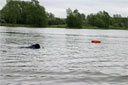
Desired performance - The dog will remain on shore, under control, at the side of the owner, until instructed to begin. A boat will proceed on
a course parallel to the shore. In full view of the dog, the steward will hold the article above their head and then on the Judge's signal drop it into
the water as they pass so that the dog will have to swim at least 15 metres to the article. The Judge will immediately give the indication to begin, while
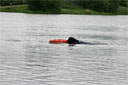
the boat leaves the test area. The dog will be sent to retrieve the object from the water and return it to the shore. The Judge shall indicate that the
exercise is complete when the dog and the owner with the object are back on shore
Scoring - Points will be lost for:
excessive anticipation or lack of control;
hesitation in entering the water;
the dog being physically redirected;
not swimming directly to the object;
not turning when instructed;
not swimming directly back to the shore;
dropping the object before getting it back to the shore within the test area;
not giving the object to the owner when instructed;
not leaving the water when instructed.
The pass mark is 18 out of 25.
Failure -
Exceeding the 4 minute limit for completing the exercise.
Permitted Actions:
The object will be selected by the Judge on the day from a hank of rope, a life ring/buoy, a life jacket/ buoyancy aid or a boat cushion and it will be
the same for each dog. In selecting the article the Judge will take into account their suitability having regard to all the circumstances.
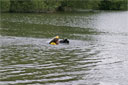
Purpose - To demonstrate a dog's ability to respond to the owner's commands and swim safely with the owner, without interfering with them.
Desired performance - During this exercise the dog and owner will be required to swim together for at least 45 metres and not more than 50 metres.
Perform a minimum of two turns so that they are swimming parallel to the shore for at least 15 metres. The route to be taken should be either:-
'n' shaped with a swim out of at least 15m, turn to swim at least 15m parallel to the shore and then a further turn and swim back the last at least 15m
to the shore.
A triangle with a swim out of at least 15m, turn to swim at least 15m parallel to the shore and then a further oblique turn and swim back the last at
least 15m to the entry point on the shore.
An inverted 'L' with a swim out of at least 15m, turn to swim at least 7.5m parallel to the shore, then an about turn over the same route to return to
the shore at the entry point.
The choice of route will be decided by the Judges depending on the environment and weather conditions on the day of the test and will be the same for
each dog; the Judges may vary distances according to venue or conditions but without reducing the overall distance.
On the judges instruction the dog, off lead, and owner will leave the shore together and swim out following the route previously detailed by the Judges.
The dog will swim at the side of the owner close enough to be verbally/visually controlled (within 2m) but not too close so as to interfere with the stroke
of the swimmer. The dog will swim independently throughout the exercise; it will not tow the owner during the exercise. Note: The points at which to make
turns will be clearly indicated audibly and/or visually by the Judges, e.g. whistle, loud hailer, flag, etc.
Scoring - Points will be lost for:
excessive anticipation or lack of control;
hesitation in entering the water;
not being close enough to the swimmer;
being too close, so as to interfere with the stroke of the swimmer;
physically redirecting the dog;
not turning when instructed;
not leaving the water when instructed.
The pass mark is 18 out of 25.
Failure -
Exceeding the 5 minute limit for completing the exercise.
Attempting to climb on the owner.
Owner swimming on their back with the dog following them.
Dog swimming off and the owner chasing it.
Owner swimming off and the dog chasing them.
Wearing fins or swimming aids, other than webbed gloves.
Permitted actions -
When entering the water together the owner may hold the harness/dog only until the dog is swimming.
If for any reason the owner stops swimming then the dog is permitted to circle the owner as many times as necessary, but should not at any time be more
than 2 m (approximately) from the owner's head.
The Judges will indicate a target to aim for so that they can see that the dog and owner are swimming on line, but there will be no buoys close in to
the test area that would act as an attraction or a danger for the dog.
Distances will be measured from when the dog and owner start swimming.
For the turns to swim parallel to the shore and the return to shore the Judges will arrange in advance how they will signal to each other and the entrant
- whistles may be reinforced with a visual signal.
A Judge will be in a boat at a safe distance from the dog and owner to give a better perspective to the actual swim.
It is the owner's responsibility to swim or provide a person to swim with their dog; it cannot be assumed that a steward will automatically be available
to take on this role without prior arrangement.